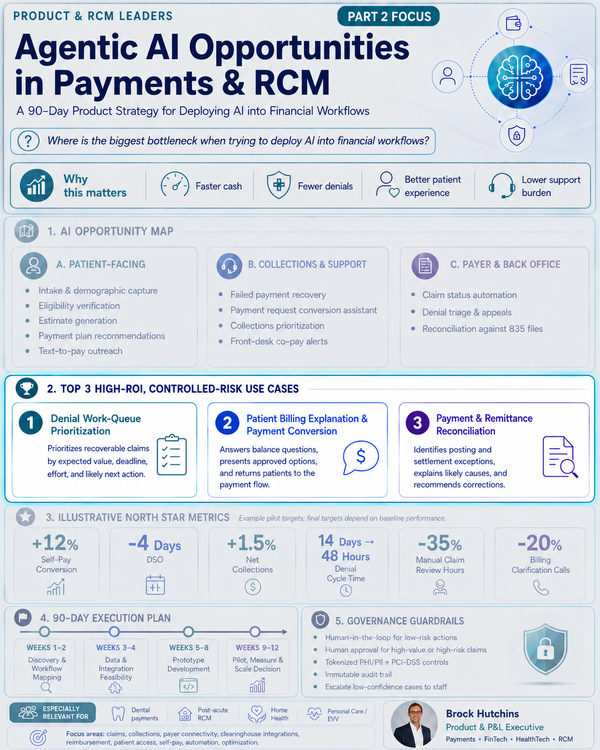
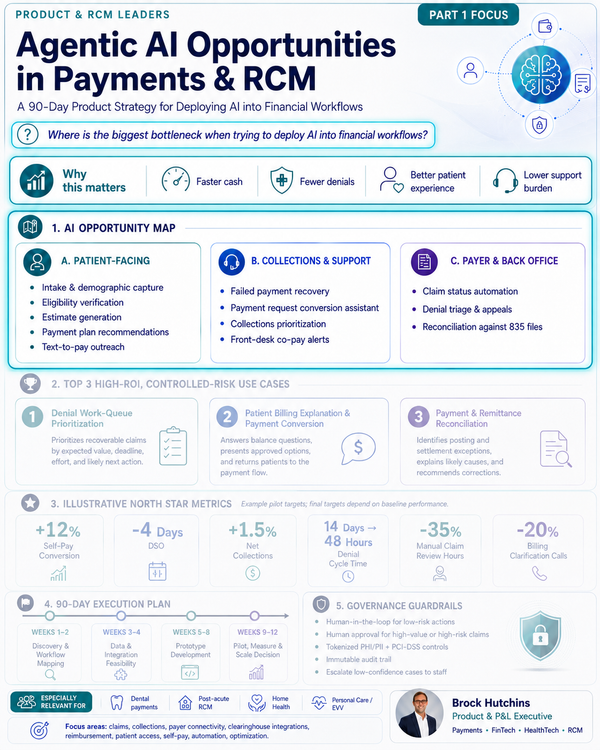
The AI Opportunity Map for Payments & RCM - Part Three
A 90-day framework for moving an AI use case from workflow discovery through pilot measurement, governance, and scale decisions.
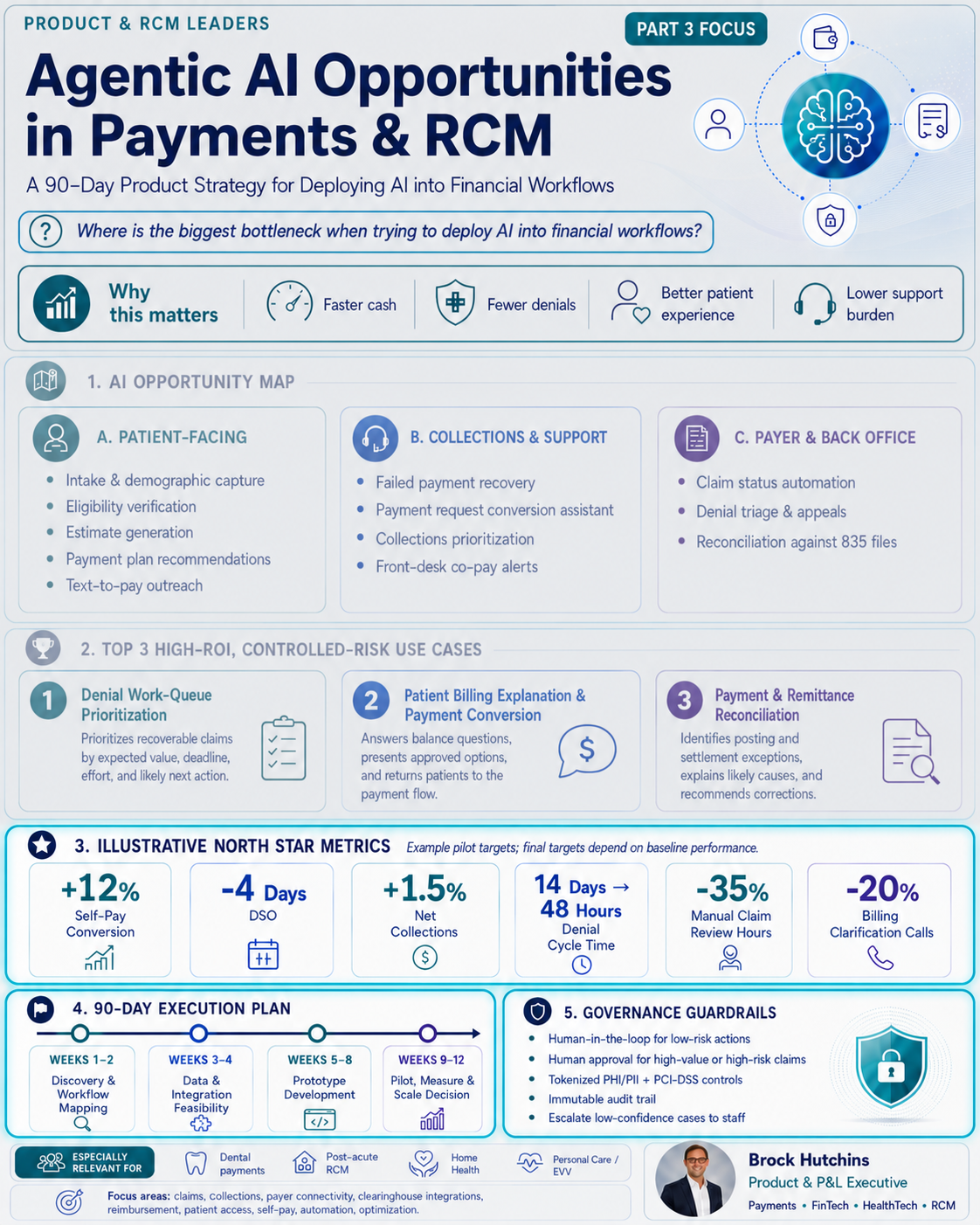
This is Part Three of a three-part series on identifying, funding, and deploying AI opportunities across payments and revenue cycle management.
Part One: Where AI creates value
Part Two: The first three use cases to fund
Part Three: A 90-day deployment framework
From AI Prototype to Controlled RCM Deployment: A 90-Day Framework
Selecting the right AI use case is only the beginning.
The larger product challenge is turning that use case into something that works reliably inside a real revenue-cycle workflow.
That is where many AI initiatives stall.
A model performs well in a demonstration. The organization sees potential. A pilot is announced. Then the team encounters fragmented data, legacy integrations, inconsistent workflows, unclear approval rules, low employee adoption, and no credible way to measure whether the product is improving the business.
The problem is usually not the model.
The problem is that the organization treated the model as the product.
From my perspective, a production-ready AI capability is the full operating system around the model:
- The data it can access
- The rules it must follow
- The workflow in which it appears
- The actions it may recommend
- The actions it may execute
- The people who review it
- The evidence supporting its output
- The controls that constrain it
- The metrics used to evaluate it
A 90-day plan should not attempt to transform the entire revenue cycle.
It should determine whether one tightly scoped use case deserves further investment.
Five Principles for Implementation
1. The LLM is a component, not the product
A production-ready AI capability requires more than access to a large language model.
It requires:
- Reliable data ingestion
- Retrieval of relevant records and policies
- Deterministic business rules
- Model orchestration
- Workflow design
- Human-review controls
- Auditability
- Monitoring
- Evaluation
- Error handling
The model may generate an explanation, classification, or recommendation. The surrounding product determines whether that output is useful, safe, and economically valuable.
2. Improve a specific operational decision
The initiative should begin with a clearly defined decision.
For denial prioritization, that decision might be:
Which claim should this specialist work next, and why?
For patient billing:
What information or action will most effectively resolve this patient’s question and return the patient to the payment flow?
For reconciliation:
Which exception should be investigated next, what likely caused it, and what correction should be reviewed?
Those are usable product definitions.
“Use AI to improve denials” is not.
A specific decision gives the team a clear user, workflow, input set, action, risk boundary, and success measure.
3. Embed the capability into the operating workflow
AI should reduce the distance between information and action.
A denial recommendation that appears only in a separate dashboard is less valuable than one embedded directly into the specialist’s work queue with the relevant evidence, deadline, and recommended next step.
The same applies to patient payments and reconciliation.
The product should appear where the employee or patient is already working. It should not create another disconnected system that users must remember to check.
4. Combine AI with deterministic rules
Not every part of the workflow should be delegated to a model.
Deterministic rules are generally better suited to:
- Filing deadlines
- Approval thresholds
- Patient consent
- Communication frequency
- Payment retry permissions
- Card-network restrictions
- Role-based access
- Required documentation
- Ledger controls
- Escalation requirements
AI is better suited to interpretation, prioritization, summarization, explanation, and recommendation where ambiguity exists.
Rules should enforce the non-negotiable boundaries.
5. Earn automation through evidence
I would begin with decision support and expand automation only where production evidence justifies it.
A sensible progression is:
- AI summarizes and classifies.
- AI recommends an action.
- AI prepares the action for approval.
- AI executes a narrow set of reversible, low-risk actions.
- Automation expands only after sustained performance.
This allows the organization to identify where the product performs reliably and where human judgment remains essential.
Automation should be earned through evidence.
Data and Integration Requirements
The architecture will vary by use case, but an RCM product may require access to:
- EHR and practice-management data
- X12 claim and remittance transactions
- Clearinghouse responses
- Payer APIs and portals
- Payment-processor APIs
- Bank and settlement data
- General-ledger records
- Communication platforms
- Contract and payer-policy repositories
- Clinical and billing documentation
Supported APIs and standard transactions should generally be preferred where available.
Browser automation can fill important gaps, particularly in payer workflows, but it should be treated as a managed fallback rather than the foundation of the architecture.
Portal interfaces change. Authentication requirements evolve. Payer-specific workflows break. Any browser-based component requires monitoring, failure detection, exception routing, and clear maintenance ownership.
The implementation team should also account for the quality of the underlying data.
The key questions are not simply whether a field exists, but whether it is:
- Complete
- Timely
- Consistent
- Linked to the correct account or claim
- Interpretable
- Legally usable
- Connected to a measurable outcome
A model cannot compensate indefinitely for a broken data environment.
Governance Begins with Product Design
Governance should not be added after the prototype appears successful.
The team should determine early:
- What the AI may retrieve
- What it may infer
- What it may recommend
- What it may prepare
- What it may execute
- Which actions require approval
- How uncertainty is shown
- How overrides are recorded
- When automation is suspended
- How errors are investigated
- How models, prompts, rules, and policies are versioned
A system is not meaningfully human-controlled merely because it includes an approval button.
The reviewer must have enough evidence, time, context, and authority to exercise judgment.
Risk-Based Human Oversight
The level of human involvement should increase with:
- Financial exposure
- Patient impact
- Model uncertainty
- Novelty
- Legal or contractual complexity
- Irreversibility
- Data incompleteness
- Evidence of drift
- Historical override rates
Users should be able to:
- Review
- Approve
- Reject
- Edit
- Override
- Escalate
- Suspend
- Reverse where possible
Approval requirements should not be based on dollar value alone.
A lower-value action may still require review if it affects patient responsibility, involves unclear documentation, relies on contractual interpretation, or falls outside established policy.
Auditability
Every material recommendation or action should record:
- Input data
- Data sources
- Model and version
- Prompt or instruction version
- Retrieved evidence
- Rules applied
- Confidence or uncertainty
- Recommendation
- Human response
- Final action
- Timestamp
- User or system identity
- Subsequent outcome
Logging the prompt is not enough.
The organization should be able to reconstruct why the recommendation was made, what evidence supported it, who approved it, and what happened afterward.
Confidence and Escalation
I would avoid applying one universal confidence threshold across all workflows.
Thresholds should vary based on:
- Use case
- Action type
- Financial value
- Data completeness
- Historical error rate
- Patient impact
- Payer or denial category
- Reversibility
When the system falls outside approved limits, it should:
- Stop the automated action
- Explain the uncertainty
- Route the record to the correct specialist
- Preserve the supporting context
- Record the reason for escalation
The product should not merely say that it is uncertain. It should make the uncertainty operationally manageable.
Measuring Success
A credible scorecard should connect model behavior to product adoption, operational performance, financial outcomes, and patient impact.
Financial outcomes
- Payment-conversion lift
- Self-pay collections
- Recovered denial dollars
- Recovered dollars per staff hour
- Avoidable write-offs
- Cost to collect
- Unapplied cash
- Pilot return on investment
Operational outcomes
- Average touches per account or claim
- Appeal cycle time
- Work-queue aging
- Manual-review hours
- Exception-resolution time
- Reconciliation backlog
- Billing-related call volume
- Staff throughput
Product adoption
- Staff adoption
- Recommendation acceptance
- Workflow completion
- Repeat usage
- Time to first value
- Abandonment
- User satisfaction
Decision quality
- Classification accuracy
- False-priority rate
- Override rate
- Escalation rate
- Confidence calibration
- Documentation completeness
- Unsupported-answer rate
- Error rate by payer, denial type, or customer cohort
Patient experience
- Payment completion
- Billing-question resolution
- Complaint rate
- Opt-out rate
- Human-escalation rate
- Dispute rate
- Accessibility
- Language quality
Targets should be based on the existing baseline, not selected arbitrarily before the team understands current performance.
A pilot should demonstrate meaningful improvement after accounting for technology, labor, messaging, processing, integration, and vendor costs.
The 90-Day Framework
Weeks 1–2: Workflow discovery and baseline measurement
Embed with the people performing the work.
Document:
- The current process
- Decision points
- System handoffs
- Exceptions
- Failure modes
- Workarounds
- Staff touch time
- Existing queue logic
- Current financial performance
- Error patterns
- Escalation patterns
- Existing controls
The unofficial workflow often differs from the documented workflow. The product team needs to understand both.
The key deliverables are:
- A clearly defined operational decision
- A defined user and workflow
- A measurable baseline
- An initial risk boundary
Weeks 3–4: Data, integration, and control feasibility
Validate:
- Data availability
- Data completeness
- Historical outcomes
- EHR and PMS access
- Clearinghouse access
- Payer connectivity
- Payment-processor capabilities
- Security and privacy requirements
- Approval rules
- Audit requirements
- Pilot population
- Evaluation method
- Expected economics
This stage should include a serious go/no-go review.
If the data, integration path, controls, or economics are not viable, the team should narrow or change the use case.
Continuing because AI is strategically fashionable is not product leadership.
Weeks 5–8: Prototype and offline evaluation
Build the controlled workflow:
- Data ingestion
- Retrieval
- Deterministic rules
- Model orchestration
- User experience
- Human-review queue
- Audit trail
- Exception handling
- Evaluation framework
- Monitoring
Test against historical cases before introducing the product into live operations.
Evaluation should include:
- Correct recommendations
- Incorrect recommendations
- False positives
- False negatives
- Missing data
- Payer variation
- Low-confidence cases
- Employee overrides
- Financial impact
- Patient impact
The team should pay particular attention to where the system is wrong with high confidence.
Those errors are usually more dangerous than obvious uncertainty.
Weeks 9–12: Controlled pilot and investment decision
Launch with a narrow population, such as:
- Selected clinics
- Specific payers
- Defined denial categories
- A limited staff group
- A particular patient cohort
- A controlled balance range
- A defined set of reconciliation exceptions
Compare results against a baseline or control group.
At the end of the pilot, the available decisions should include:
- Scale
- Expand cautiously
- Revise
- Narrow the use case
- Add controls
- Improve the data
- Rework the workflow
- Stop
The pilot should have explicit stop criteria as well as scale criteria.
Stopping a weak initiative is not failure.
Scaling one without evidence is.
Questions the Product Team Should Answer Before Funding
Before approving an AI initiative in payments or RCM, I would expect credible answers to six questions:
1. What decision are we improving?
The use case should be defined as an operational decision or action, not a broad technology objective.
2. What economic or customer outcome should change?
The team should explain how the product affects collections, cost, cash flow, staff capacity, operational risk, or patient experience.
3. Is the required data reliable and usable?
The inputs should be available, sufficiently complete, timely, legally usable, and linked to measurable outcomes.
4. What happens when the system is wrong?
The team should understand the financial, operational, compliance, and patient consequences of an incorrect recommendation or action.
5. Where is human approval required?
Approval boundaries should be based on risk, reversibility, confidence, and impact—not simply on whether the technology can automate the step.
6. What evidence would cause us to stop?
The initiative should have explicit failure criteria, not only targets for scaling.
If those questions do not have credible answers, the organization is not ready to deploy.
It is still exploring.
Conclusion
Moving from an AI prototype to a controlled RCM deployment requires more than proving that a model can generate a useful answer.
The organization must prove that the product can improve a specific decision, operate inside the existing workflow, respect defined controls, earn user trust, and produce measurable value.
That is the real purpose of the 90-day framework.
The goal is not a broad production rollout. It is an evidence-based investment decision. From my perspective, the strongest outcome after 90 days is not necessarily “scale.”
It is clarity.
Clarity about where the product works. Where it fails. Where human judgment remains essential. What the economics support. And whether it has earned the right to expand.
Continue the series
Start from the beginning: Part One — Where AI creates value