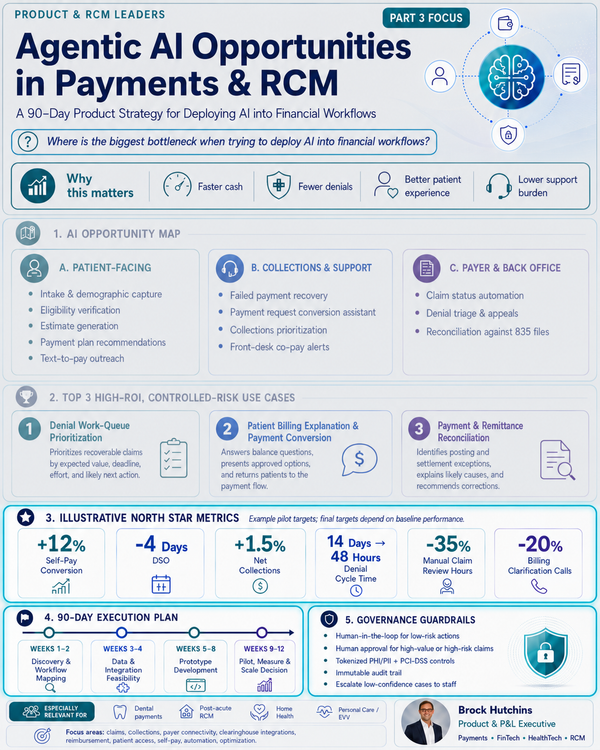
The AI Opportunity Map for Payments & RCM - Part One
A practical map of the highest-value AI opportunities across patient payments, collections, support, payer workflows, and healthcare RCM.
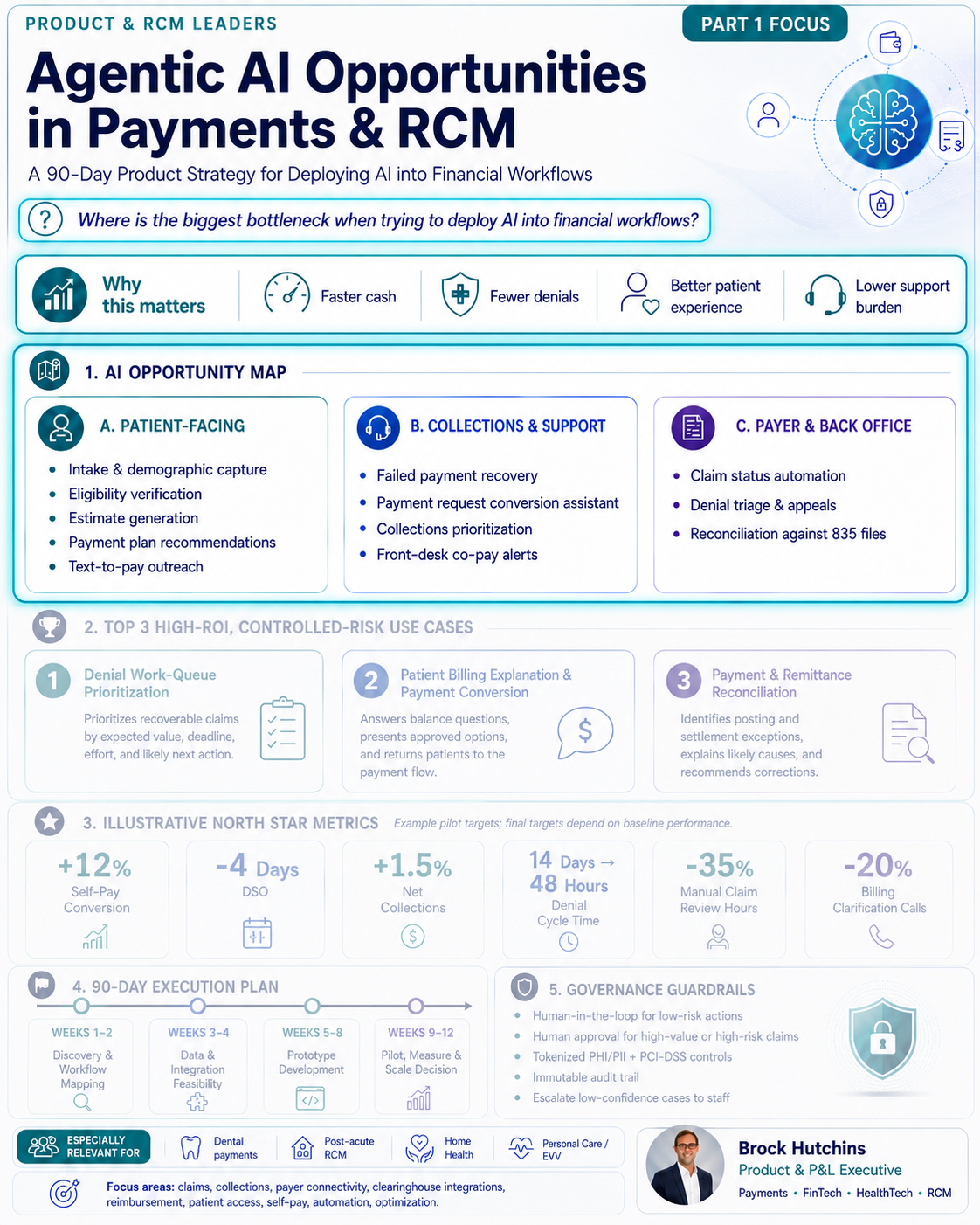
This is Part One of a three-part series on identifying, funding, and deploying AI opportunities across payments and revenue cycle management.
Part One: Where AI creates value
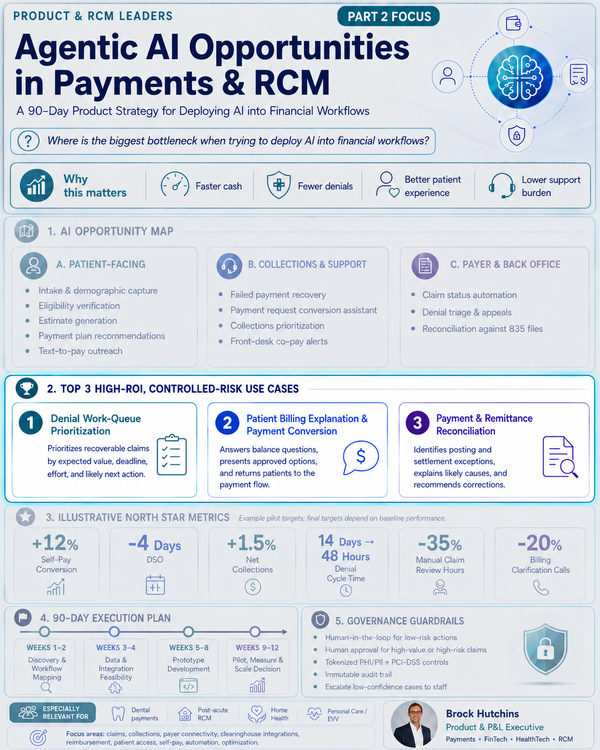
Part Two: The first three use cases to fund
Part Three: A 90-day deployment framework
Where AI Creates Value in Payments and Revenue Cycle Management
I have spent much of my career building and improving products that span patient payments, healthcare finance, revenue cycle management, and regulated workflow automation.
Across those environments, I have seen the same pattern repeat: the most compelling technology demonstration is rarely the best place to begin.
That is especially true with artificial intelligence.
AI can materially improve revenue-cycle performance, but the opportunity is not distributed evenly across every workflow. Some use cases can reduce administrative effort, accelerate collections, and improve the patient experience within months. Others introduce significant integration, compliance, operational, or reputational risk without a clear path to measurable value.
The first question should not be:
Where can we use AI?
The more useful questions are:
- Where can AI improve a consequential business outcome?
- Where is the underlying data reliable enough to support the decision?
- Where can the capability fit naturally into an existing workflow?
- Where can we establish clear boundaries between automation and human judgment?
- Where can we measure whether the investment is actually working?
The best first AI use cases are therefore not necessarily the most ambitious. They are the ones with meaningful economic value, sufficient data, bounded decision authority, and a clear mechanism for human oversight.
The Revenue Cycle Is Not One Workflow
The revenue cycle is a network of financial, administrative, clinical, and operational decisions distributed across patients, providers, payers, clearinghouses, payment processors, and internal finance teams.
That fragmentation creates both the opportunity and the difficulty.
The opportunity comes from the volume of repetitive work, unstructured data, manual interpretation, system switching, and exception handling.
The difficulty is that these workflows often depend on incomplete information, payer-specific rules, legacy integrations, and decisions that can materially affect patients or provider economics.
In my experience, AI creates the most value when it improves the quality, speed, or consistency of a defined operational decision.
It is less effective when organizations apply it broadly without first understanding or redesigning the underlying workflow.
The opportunity can be organized into three broad areas:
- Access and pre-service
- Patient financial engagement
- Payer and back-office operations
1. Access and Pre-Service
These workflows occur before or near the point of care. They shape whether the organization has accurate information, whether coverage risks are identified early, and whether the patient understands the likely financial responsibility.
Patient Intake
AI can extract and pre-populate demographic, insurance, guarantor, referral, and administrative information from forms, insurance cards, images, and scanned documents.
The basic automation is relatively mature. The harder product problem is managing conflicting information.
When a patient form, insurance card, and existing system record do not match, the system should not silently choose one source. It should identify the discrepancy, explain it, and route the record for review.
AI should not obscure uncertainty. It should make uncertainty easier to manage.
Eligibility and Coverage Verification
AI can initiate eligibility checks, interpret payer responses, and identify potential issues such as inactive coverage, coordination-of-benefits conflicts, missing authorization, coverage limitations, and unexpected patient responsibility.
The opportunity is not simply to automate the eligibility inquiry. Most organizations can already perform that transaction.
The higher-value capability is interpreting the result in the context of the scheduled service and recommending the next operational action.
That might include requesting additional information, initiating an authorization workflow, contacting the patient, or escalating an inconsistency for staff review.
AI should surface risk early. It should not independently determine whether a patient can receive care.
Patient Estimate Generation
AI can improve estimates by combining contracted rates, eligibility information, deductible and coinsurance status, procedure data, prior adjudication results, and payer-specific behavior.
The implementation lesson is that accuracy alone is not enough.
A technically sophisticated estimate that appears definitive but later proves incorrect can create more distrust than a clearly explained range.
A responsible estimate should identify the information used, the assumptions made, what remains unconfirmed, and why the final amount may change.
The product goal should be better financial clarity, not false precision.
Payment-Option Recommendations
AI can help select and explain an appropriate payment path from options already approved by the organization.
Those options may include payment in full, installments, financing, partial payment, financial-assistance screening, or escalation to staff.
This capability requires discipline.
I would avoid making payment options dependent on an opaque prediction about a patient’s willingness or ability to pay. Recommendations should rely on transparent factors such as balance amount, patient preference, existing arrangements, financial-assistance policy, and organizational approval rules.
AI can help select and explain the option. It should not invent financial policy.
2. Patient Financial Engagement
These use cases sit closer to the moment when a patient is trying to understand, dispute, or pay a balance.
This is where AI can directly connect customer experience to financial performance.
Billing Explanation and Payment Conversion
Many payment requests do not fail because the patient refuses to pay. They fail because the patient does not understand the balance.
Traditional text-to-pay experiences often provide an amount and a payment link with very little context. When the patient has a question, the digital experience ends and the patient must call the billing office.
That is a conversion problem disguised as a support problem.
Conversational AI can answer common questions using claim, payment, benefit, and account data, then return the patient directly to the payment flow.
The system must also recognize when the patient is not asking for an explanation but disputing the charge, reporting hardship, or identifying a possible billing error. Those situations require a different workflow and often human intervention.
Contextual Patient Outreach
AI can generate and sequence SMS or email outreach based on account status and prior patient engagement.
The value does not come from making every message sound more personalized. It comes from responding appropriately to what has already happened.
A patient who never opened a payment request should not receive the same follow-up as one who opened it, asked a question, attempted to pay, and encountered an error.
The system should distinguish among lack of awareness, confusion, technical failure, financial hardship, an unresolved insurance issue, and a disputed balance.
The next action should follow from that context rather than defaulting to another generic reminder.
Failed-Payment Recovery
AI can identify recoverable payment failures and recommend the next-best action.
That action may involve requesting an updated payment method, offering a different payment channel, presenting a payment plan, sending a contextual message, retrying the transaction when permitted, or routing the account to staff.
The intelligence is not in repeatedly retrying a card.
It is in understanding why the payment failed, which actions are allowed, and which action is most likely to resolve the issue without creating a poor patient experience.
The payment platform—not the model—must enforce authorization, card-network, processor, legal, and organizational rules.
3. Payer and Back-Office Operations
This category includes many of the most labor-intensive and financially consequential workflows in RCM.
It is also where AI can be especially effective at assembling fragmented information, prioritizing work, and reducing manual investigation.
Claim-Status Retrieval
AI agents can retrieve and interpret claim-status information through supported transactions, payer APIs, clearinghouse integrations, or controlled browser automation.
Browser automation receives significant attention because it can reach workflows where APIs are unavailable. It can also be brittle.
Portal designs change. Authentication requirements evolve. Access terms differ by payer. A workflow that succeeds in a demonstration may become difficult to maintain across a large payer network.
I view browser automation as a controlled fallback, not the foundation of the architecture.
Where it is necessary, the product should include failure detection, exception routing, monitoring, and clear ownership for maintaining each payer workflow.
Denial Classification and Root-Cause Analysis
AI can interpret claim and remittance data to identify the denial reason, probable root cause, missing information, coding or authorization issues, filing-limit exposure, payer-specific patterns, and similar prior cases.
This matters because denial codes rarely tell the entire story.
The information required to resolve a denial may be distributed across the remittance, original claim, coverage data, authorization records, payer policy, documentation, and staff notes.
AI can assemble that context and explain the likely cause.
The product should not stop at categorization. The operational value comes from identifying what should happen next.
Denial Work-Queue Prioritization
Denial teams often work claims based on age, balance, payer, or basic queue rules. Those approaches are understandable, but they do not always direct limited capacity toward the highest-value opportunities.
AI can help prioritize work based on claim value, filing deadline, denial type, historical recoverability, required effort, available documentation, payer behavior, and probability of resolution.
The objective is not to create a perfect prediction.
It is to improve the order in which work is performed so the organization recovers more with the same—or less—staff effort.
The metric I would emphasize is:
Recovered dollars per staff hour.
Appeal Preparation
Generating an appeal letter is one of the most obvious uses of generative AI. It is useful, but it is not the most differentiated part of the product.
The greater value lies in the decision system surrounding the appeal.
The system should help determine whether the denial is recoverable, what caused it, what evidence is missing, which deadline applies, what the expected value is, who should handle it, and what happened in similar cases.
Once those questions are answered, AI can assemble draft language, supporting documentation, payer policy references, and submission checklists.
High-value, unusual, low-confidence, or policy-sensitive appeals should remain subject to explicit human approval.
Collections Prioritization
AI can segment past-due accounts and recommend an appropriate next action, such as additional outreach, a payment-plan offer, financial-assistance screening, staff review, or external collections referral.
This is an area where an optimization mindset can create risk.
A financially efficient workflow is not necessarily a good patient experience. Product leaders must account for hardship, unresolved insurance issues, disputed balances, contact fatigue, complaint risk, and equitable access to assistance.
The system should optimize for sustainable recovery, not maximum short-term pressure.
Payment and Remittance Reconciliation
AI can compare processor, settlement, bank, patient-ledger, general-ledger, and remittance data to identify missing deposits, unapplied payments, duplicate transactions, posting errors, refund inconsistencies, and unresolved exceptions.
I would not begin by allowing AI to modify the ledger autonomously.
I would begin with exception identification, explanation, prioritization, and recommended corrective action.
That can materially reduce manual investigation while leaving financial control with the appropriate employee.
Front-Desk Assistance
AI can surface relevant operational alerts during registration or check-in, including outstanding copays, missing insurance information, incomplete forms, authorization concerns, unresolved balances, and available payment options.
The product challenge is not producing more alerts. Front-desk teams already receive too many.
The challenge is determining which alert matters now and what action the employee should take.
An effective assistant should prioritize a small number of actionable recommendations, explain why each matters, and avoid interrupting the workflow with low-value information.
The Product Decision Comes Next
The AI opportunity across payments and RCM is substantial but mapping the opportunities is the easy part.
The harder product decision is determining which workflows have enough economic value, operational burden, data readiness, integration feasibility, measurability, and controllable risk to justify investment.
That is where product leadership matters.
The goal is not to identify every place AI could be added. It is to identify the few places where AI can improve a meaningful decision, fit into the operating workflow, preserve appropriate human control, and produce measurable value.
In the next article, I will outline how I evaluate these opportunities and identify the three AI use cases I would fund first.
Continue the series
Next: Part Two — The first three use cases to fund