The AI Opportunity Map for Payments & RCM - Part Two
Three high-value, controlled-risk AI use cases that payments and RCM product teams can fund, test, and deploy first.
This is Part Two of a three-part series on identifying, funding, and deploying AI opportunities across payments and revenue cycle management.
Part One: Where AI creates value
Part Two: The first three use cases to fund
Part Three: A 90-day deployment framework
The Three RCM AI Use Cases I Would Fund First
In Part One, I mapped the major AI opportunities across access, patient financial engagement, payer operations, and back-office revenue-cycle workflows.
That map is intentionally broad. The next product decision is narrower:
Which use cases are strong enough to justify investment now?
From a CPO’s perspective, the objective is not to create the largest possible AI roadmap. It is to identify the few workflows where AI can improve an important operational decision, produce measurable economic value, fit into the existing operating model, and maintain appropriate human control.
Before funding any use case, I would ask the product team to evaluate and quantify the opportunity across six dimensions.
The Investment Framework
Financial impact
The first question is whether the use case can produce a measurable economic result.
That may come from higher collections, faster cash realization, fewer avoidable write-offs, lower cost to collect, reduced vendor expense, or increased staff capacity.
“Efficiency” is not a complete business case. The team should be able to explain what happens to the capacity created. Does the organization process more accounts, avoid additional hiring, reduce overtime, shorten close cycles, or recover more revenue?
The economic mechanism should be explicit before development begins.
Operational burden
AI is most useful in workflows that contain substantial repetition but still require interpretation.
I look for work involving repeated system switching, document review, policy lookup, exception classification, queue prioritization, and routine communication.
The process should be consistent enough to model, but complex enough that static business rules alone do not solve it.
Data readiness
Many AI initiatives begin with the model when they should begin with the data.
Before approving investment, I would want to know whether the necessary inputs are available, timely, sufficiently complete, and linked across the relevant systems.
Historical outcomes matter as well. If the organization cannot distinguish a good recommendation from a bad one, it cannot credibly evaluate the product.
A sophisticated model operating on fragmented or unreliable data will usually produce sophisticated-looking uncertainty.
Decision risk
Every use case should be evaluated based on the consequence of being wrong.
Can the action be reversed? Can it affect patient access, patient financial responsibility, claim submission, movement of funds, contractual obligations, or the general ledger?
The greater the financial, legal, operational, or patient impact, the narrower the initial automation boundary should be.
AI may be ready to recommend a decision well before it is ready to execute that decision independently.
Integration complexity
The business case must reflect the real cost of embedding the capability into production.
That includes EHR and practice-management constraints, clearinghouse connectivity, payer variability, payment-processor requirements, document access, authentication, workflow orchestration, and portal-automation dependencies.
A model that performs well outside the operational system has limited value.
The capability must reach the employee or patient at the moment the decision is being made.
Measurability
Every initiative should begin with a clear definition of success and failure.
The team should be able to compare results against a baseline, control group, current work-queue logic, existing staff performance, or the prior patient experience.
I would also define stop criteria before funding the pilot.
Teams are usually comfortable defining what would justify scaling. They are less comfortable defining what evidence would require them to narrow, redesign, or terminate the initiative.
That discipline matters.
The Three Use Cases I Would Fund First
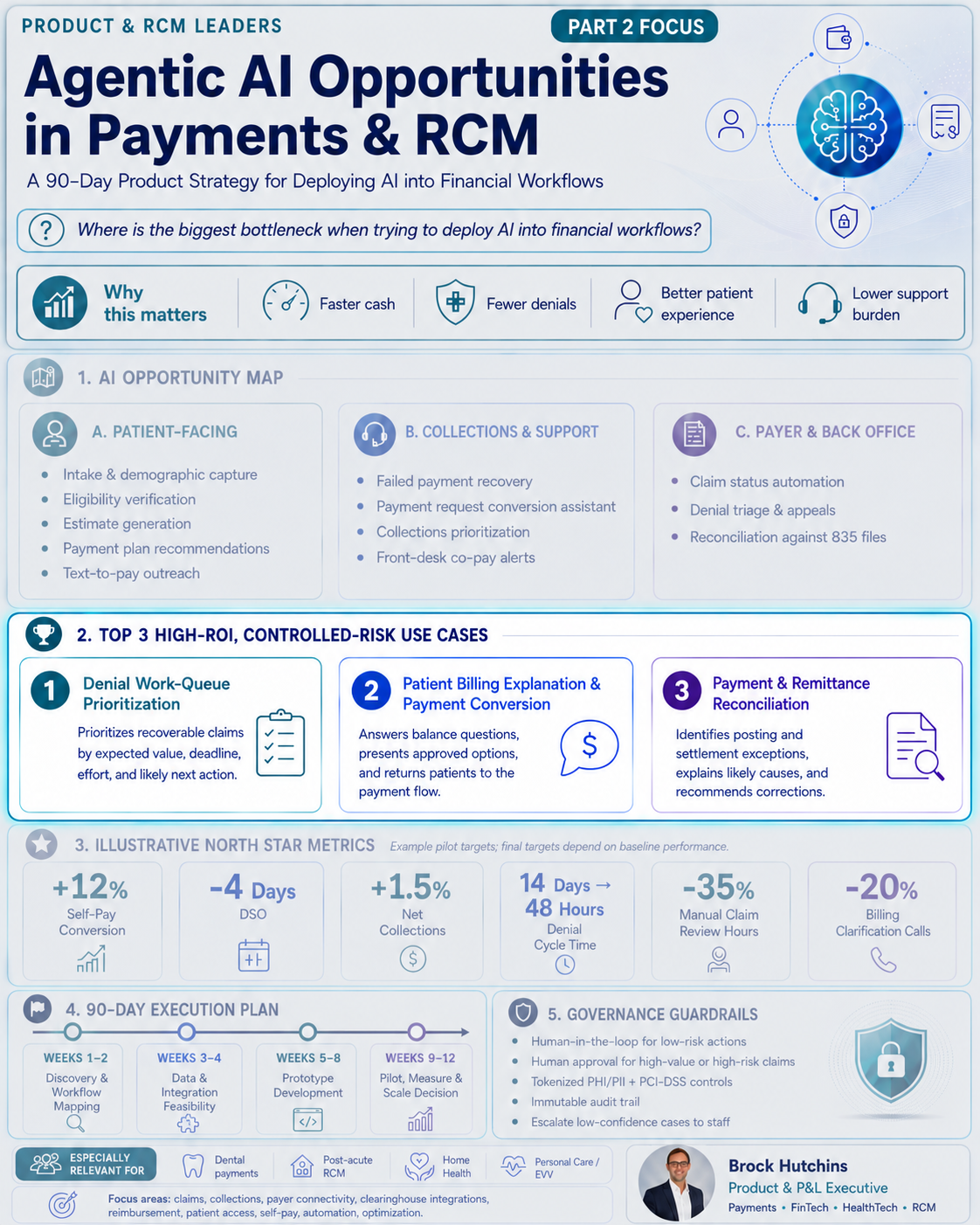
Based on the balance of financial value, operational burden, data availability, implementation feasibility, and controllable risk, I would begin with three use cases.
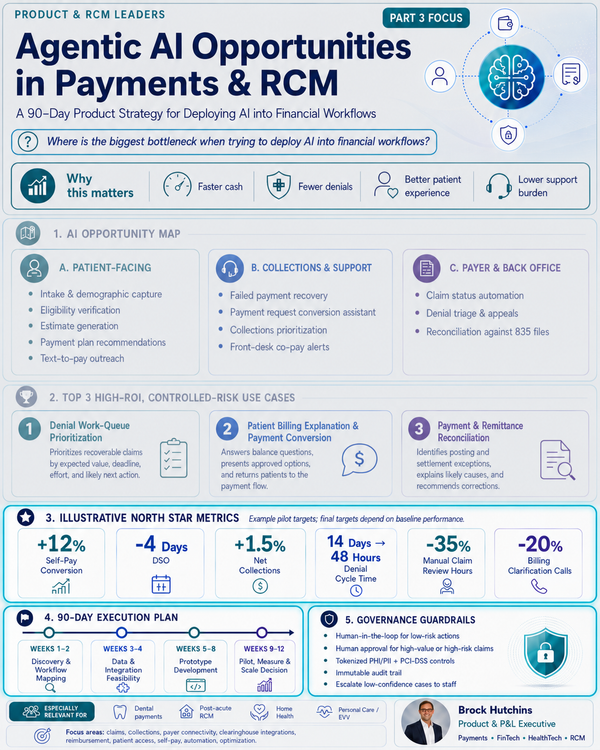
1. Denial Work-Queue Prioritization
What it does
The system combines claim, remittance, payer, deadline, documentation, and historical-resolution data to determine:
- The likely root cause of the denial
- Whether the claim appears recoverable
- The estimated financial value
- The relevant filing or appeal deadline
- The recommended next action
- The appropriate employee or work queue
It may also prepare supporting information, documentation checklists, or draft appeal materials for review.
Why it matters
Denial teams often work claims based on age, balance, payer, or relatively basic queue rules.
Those methods are understandable, but they do not always direct limited staff capacity toward the claims with the highest expected return.
The goal is not to predict every outcome perfectly. It is to improve the order in which work is performed.
The system should help specialists focus on the claims where their judgment and effort are most likely to produce financial value.
How I would measure it
The primary metric I would emphasize is:
Recovered dollars per staff hour.
Supporting measures could include:
- Denial work-queue aging
- Appeal cycle time
- Timely-filing losses
- Average touches per claim
- Recovery rate by denial category
- Recommendation acceptance rate
- Override rate
- Incorrect-priority rate
That creates a direct connection between operational productivity and financial performance.
Where human control remains necessary
Human review should remain central for high-value, unusual, low-confidence, clinically sensitive, or contractually complex claims.
Staff should also approve cases where documentation is incomplete, coding judgment is required, patient responsibility may change, or the recommendation conflicts with policy.
The first version of the product should improve prioritization and preparation. It should not attempt to replace expert judgment.
2. Patient Billing Explanation and Payment Conversion
What it does
The system combines contextual outreach with conversational balance explanation.
It can help a patient understand:
- What the charge relates to
- Whether insurance has processed the claim
- Why a balance remains
- Whether a payment has already been applied
- Which approved payment options are available
- How to escalate a dispute or billing concern
After answering the question, the system can return the patient directly to the payment experience.
Why it matters
Many digital payment requests fail because the patient does not understand the bill.
Traditional text-to-pay experiences often present an amount and a link but provide little context. When the patient has a question, the digital workflow ends and the patient must contact the billing office.
That is a conversion problem disguised as a support problem.
A well-designed conversational experience can improve payment conversion while reducing billing-related call volume and patient frustration.
How I would measure it
Key measures could include:
- Payment-request conversion
- Time from outreach to payment
- Billing-question resolution rate
- Call deflection
- Human-escalation rate
- Payment-plan adoption
- Patient complaint rate
- Opt-out rate
- Abandonment after a question
- Repeat engagement
The business result matters, but so does the quality of the patient experience.
A higher collection rate accompanied by a material increase in disputes, complaints, or distrust is not a successful outcome.
Where human control remains necessary
The system should distinguish between a request for explanation and a more consequential issue.
Disputes, potential billing errors, hardship, insurance conflicts, financial-assistance questions, and emotionally sensitive conversations should be routed appropriately.
The AI can explain approved information and guide the workflow. It should not invent policy, make unsupported coverage determinations, or pressure patients into inappropriate payment arrangements.
3. Payment and Remittance Reconciliation
What it does
The system compares transaction and financial data across:
- Processor authorizations and captures
- Settlement records
- Bank deposits
- Patient ledgers
- General-ledger entries
- Remittance data
- Refunds
- Reversals
- Chargebacks
It identifies potential exceptions such as missing deposits, unapplied payments, duplicate transactions, settlement discrepancies, incorrect postings, and refund mismatches.
It can then explain the likely cause and recommend the next operational action.
Why it matters
Reconciliation work is often fragmented across payment operations, finance, RCM, and customer support.
The underlying problems may not become visible until month-end, a patient complaint, a support case, or an audit.
That makes reconciliation both expensive and operationally risky.
AI can reduce the time spent locating and interpreting exceptions, especially when the relevant evidence is spread across several systems.
How I would measure it
Useful measures include:
- Exception volume
- Average time to resolution
- Manual research time
- Unapplied-cash aging
- Posting accuracy
- Month-end close time
- Repeat exception rate
- Staff acceptance of recommendations
- Financial value of resolved exceptions
- Audit findings linked to reconciliation
The strongest use case is not simply identifying more exceptions. It is reducing the time and effort required to resolve the right exceptions.
Where human control remains necessary
I would not begin by allowing AI to modify the ledger, initiate refunds, move funds, or resolve material discrepancies autonomously.
The first stage should focus on detection, explanation, prioritization, and recommended correction.
Financial control should remain with the appropriate employee until the organization has demonstrated reliable performance across a narrow set of low-risk actions.
Why These Three
These use cases cover three different parts of the revenue cycle:
- A payer-facing workflow
- A patient-facing workflow
- A financial-operations workflow
Each has meaningful economic value. Each involves repetitive work that still requires judgment. Each can begin with decision support rather than full automation. And each can be measured against a credible baseline.
That balance matters.
The best initial AI portfolio should not be concentrated in one part of the workflow or optimized around one type of value. It should test whether the organization can improve collections, reduce administrative burden, improve the patient experience, and strengthen financial operations under a common governance model.
Conclusion
The strongest AI product strategy is not the one that funds the most use cases.
It is the one that makes disciplined choices about where AI can improve a meaningful decision, where the data is ready, where the economics are credible, and where human control can be preserved.
If I were allocating the first meaningful investment of AI in RCM, I would prioritize:
- Denial work-queue prioritization
- Patient billing explanation and payment conversion
- Payment and remittance reconciliation
The next challenge is turning one of those use cases into a controlled product deployment.
That requires more than a model. It requires workflow design, integration, governance, evaluation, and a clear 90-day path from discovery to an evidence-based scale decision.
That is the focus of Part Three.
Continue the series
Previous: Part One — Where AI creates value
Next: Part Three — A 90-day deployment framework